
What if you could avoid the complexity and trauma this involves after socket, peri-implant or soft tissue grafts?
ORA-AID is a simple, self-adhering, externally applied barrier for oral wound sites.
Ora-Aid
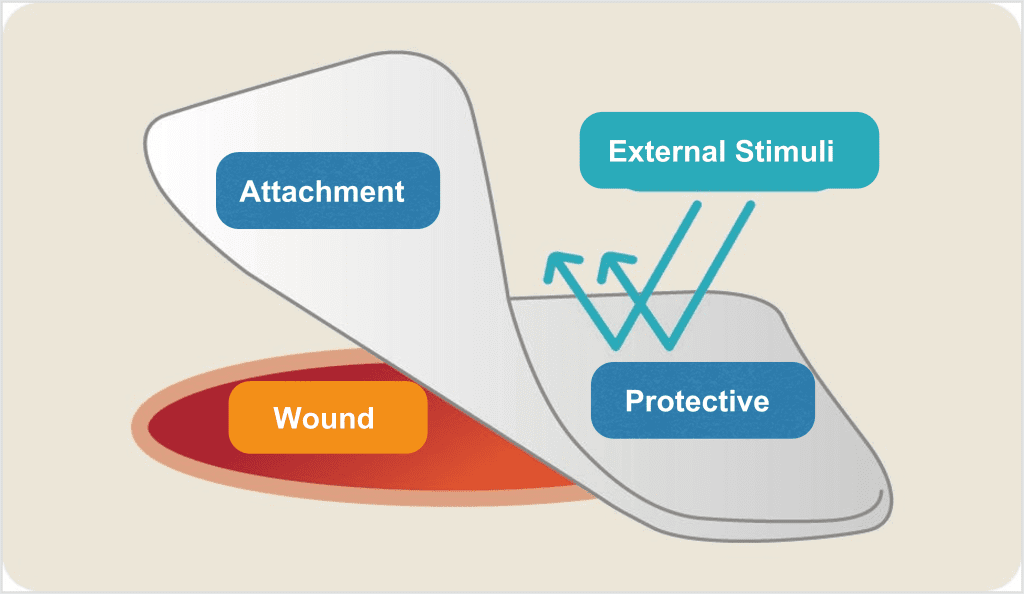
Ora-Aid has two layers. The lower layer has a cellulose-derived coating, which enables the dressing to self-adhere. The upper layer is non-permeable, meaning Ora-Aid protects the site, accelerates healing and reduces post-operative pain and discomfort.
Each Ora-Aid can be easily trimmed to match the defect shape and size, and is easy to apply.
Ora-Aid will remain attached for several hours. An extended application time is achieved with fixation using various methods, as illustrated in the following examples.
–Ora-Aid fixation with over sutures.
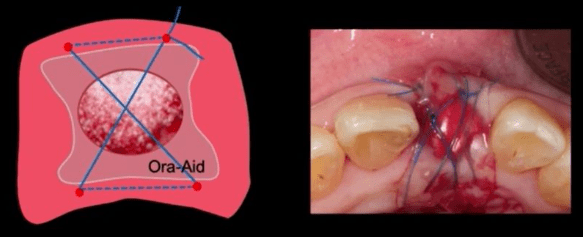
An extended application of Ora-Aid can be achieved by using a sling-type suture over the Ora-Aid, as shown in the embedded video of a socket grafted with Powerbone Dental Putty, form-stable resorbing synthetic graft.
–Ora-Aid fixation with direct sutures.
In this case, all four corners of the Ora-Aid were sutured, treating the Ora-Aid like an external barrier membrane. A CBCT taken at 14/52 revealed a stable site with good bone formation.
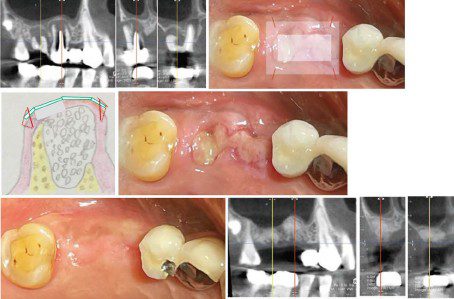
–Fixation of Ora-Aid with flowable composite to prolong the wound protection. Two cases.
Case 1 – Extraction of tooth 45.

An appropriately sized Ora-Aid was cut and applied to the socket surface, extending to the buccal side. Next, flow resin was applied over the adjacent teeth and light-cured to form a small occlusal surface. Care must be taken to ensure the resin does not have sharp edges. Remove any and light cure for a further 1 minute. This method slows immediate haemostasis without any requirement for biting on gauze. Patient response is very positive with minimal discomfort during recovery. When the patient returned for a check-up, the Ora-Aid remained present under the flowable resin.
Case 2 – Crown Lengthening.

This patient presented with serious wear on four mandibular incisors and the left mandibular molar and requested treatment to improve aesthetics. After crown lengthening on the mandibular interiors, a large Ora-Aid was cut into a comb shape and applied to the interdental and gingival wounds. Next, flow resin was used to cover the interdental spaces and adjacent teeth and light-cured to provide immediate haemostasis. When the patient returned at 9 days post op, there was no bleeding, and the Ora-Aid could still be seen under the resin. The Patient experienced no discomfort during recovery, and the teeth did not prove to be sensitive.
-Ora-Aid protection of oral ulcers (canker)

Ora-Aid can easily be applied as protection over a mouth ulcer and given to the patient to reapply at home.
More information about Ora-Aid can be found HERE
ask@regen-store.co.uk
Article adapted from Dr Wen, Application of Ora-Aid in Dental Surgical Wounds. Feb 2025.