
Upgrade your Ethos
Powerbone Dental Putty
- BEST SYNTHETIC BONE GRAFT - GROW STRONGER BONE EASIER -
Membrane Free - No Mixing - Mouldable - Ergonomic syringe - Fully Resorbing - Excellent New Bone
No Mixing
use direct from the syringe
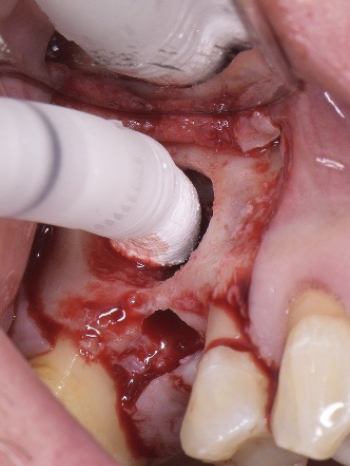
Easier & Quicker
Full patient focus.
no WASH-AWAY
unlike cements
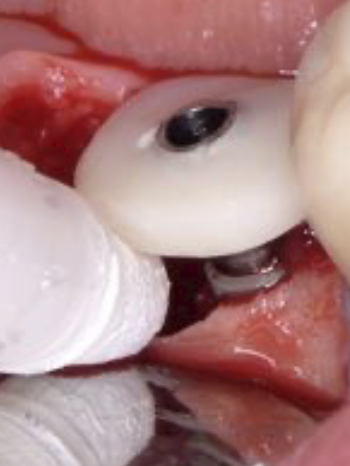
No lost graft
Efficient & Predictable.
FORM STABLE
remove micro movements
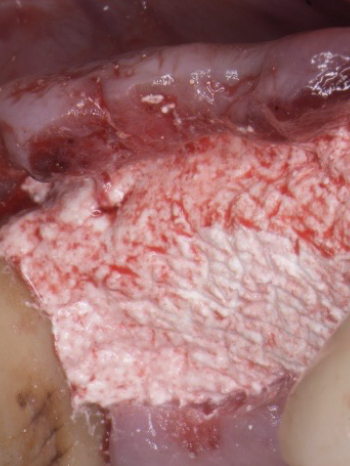
Membrane-Free
Less trauma, quick healing.
PERFORMANCE
significantly enhanced
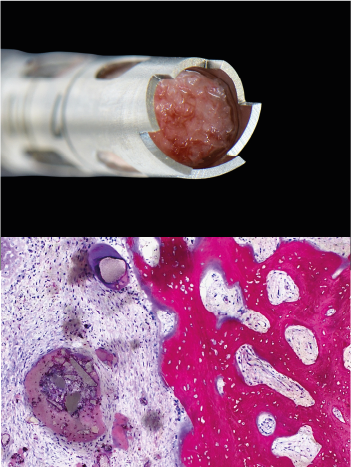
Compared with
Standard betaTCP (2,3).
Powerbone Dental Putty
True Host Bone Regeneration(1)
Contains Silicate-substituted β-TCP – ahead of standard β-TCP and equivalent to autograft (2,3,4).
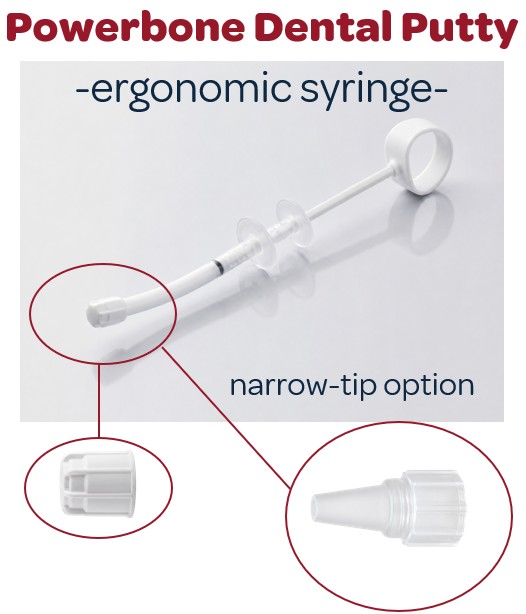
Delivers Perfect Handling – no mixing, easily moulded to defect shape with no wash-away.
Requires No Membrane – Viscoelastic holds graft firm and removes micromovement known to slow healing.
Full Resorption: Contains no hydroxyapatite and resorbs fully in a similar time to bone remodelling.
RESULTS FROM HUMAN HISTOLOGY
40-50% new bone* at 12-16 weeks.
More bone than xenograft and allograft, without negative considerations associated with cadaver or animal tissues.
SOCKETS – PERI-IMPLANT DEFECTS – DELAYED GBR – SINUS LIFT
Powerbone Dental Putty - a more refined ethoss alternative
Powerbone Dental Putty is widely used for sinus lift augmentation due to its viscoelastic form-stable consistency, no-prep syringe delivery, and membrane-free clinical protocol. In human histology studies, it has demonstrated 40–50% new bone formation at 12–16 weeks — exceeding xenograft and allograft benchmarks.
Yes. Powerbone’s viscoelastic putty formulation is form-stable on placement, eliminating micromovement that slows healing. In the majority of clinical indications — including sinus lift, socket preservation, and peri-implant defects — no separate GBR membrane is required.
Both are calcium phosphate-based synthetic bone grafts designed to be form-stable when placed, reducing micro movements that delay healing. Neither requires a membrane for containment. Powerbone contains silicate-substituted β-TCP and has human histology data demonstrating 40–50% new bone at 12–16 weeks. Unlike ethoss, Powerbone Dental Putty is supplied ready-to-use in an ergonomically curved syringe with no mixing required. The cellulose viscoelastic carrier used in Powerbone Dnetal Putty is significantly less susceptible to wash-away, which is common with calcium sulphate carriers.
Standard β-TCP (beta-tricalcium phosphate) is a widely used synthetic bone graft. Silicate substitution enhances osteogenic activity, making it equivalent to autograft in clinical studies and superior to standard β-TCP in terms of new bone formation rate and quality.
Yes. Powerbone contains no hydroxyapatite, which is the component that makes many synthetic grafts non-resorbable or very slow to resorb. Powerbone resorbs in a timeframe closely matched to natural bone remodelling.
Powerbone Dental Putty is a form-stable graft that eliminates the micromovements known to delay healing at the surface of a particulate graft. The stability is achieved without a requirement to be rock-hard, which, if achieved using plaster of Paris cement (calcium sulphate), adds complications – especially so in a wet field.
A setting powder requires rehydration immediately before use. This must be done carefully by the user to ensure even distribution of the graft within the mixture. Mixing and application must be completed within a fixed 3-to-4-minute time window to avoid setting in the syringe, bowl or on instruments.
We knew this when developing Powerbone Dental Putty. We avoided decades-old cement technology and chose a modern high-viscosity viscoelastic as the carrier. This provides the required form stability without the need to mix or wait, and provides consistently distributed graft particles from the factory. We could then pack it inside an ergonomic syringe, allowing a mouldable format, precise application and perfect defect conformity. After closure, when exposed to body heat, Powerbone Dental Putty gains additional stability while removing the need for containment by a dental membrane and associated flap management.

*23% for mineralised allograft, 17% for xenograft. (Imp D 2010;19:330-341, Valentini JOMI, 2018 N/D;33(6):1345-1350).
1. Phrase introduced by Dr Peter Fairbairn to describe Fortoss Vital (Biocomposites, Keele, Staffs – no longer available) and other similar resorbable, synthetic bone graft materials with form-stable properties.
2. Hing KA, Wilson LF, Buckland T. Comparative performance of three ceramic bone graft substitutes. Spine J. 2007; 7(4):475-490.
3. Nagineni, Vamsi V., et al. “Silicate-substituted calcium phosphate ceramic bone graft replacement for spinal fusion procedures.” Spine 37.20 (2012): E1264-E1272
4. Licina et al, Comparison of (SiCAP) with (Infuse) in Posterolateral Instrumented Lumbar Fusion Global Spine J 2015;5:471–478.
Clinical images courtesy of Dr Minas Leventis. https://dentalexelixis.co.uk/