
A thin graft can show poor survival, and a thick graft can slow healing with donor-site issues, so what is optimal, and how can you achieve it predictably?
What Is a Free Gingival Graft?
A free gingival graft is a piece of soft tissue taken from the palate and placed where gingival tissue is thin or missing. If the tissue remains thin, the implant abutment may “shine through”. Also, thin tissue is more prone to recession; as such, addition of a subepithelial connective-tissue graft (CTG) enhances the seal around the implant crown. So many clinicians choose a thicker graft as this can provide a firm, healthy keratinised tissue and be easier to clean and help protect the underlying crestal bone as well as enhancing aesthetics.
How Thick Should the Graft Be?
Many sources describe a working range of around 1 to 2 mm. Clinicians then adjust within that range. The right depth depends on:
The surgical objective.
The vascularity at the recipient site.
The thickness of the patient’s palate.
The clinician’s technique.
What Does the Evidence Suggest?
The research is helpful but not clear-cut. Reviews and clinical studies agree that thickness affects survival. It tells us that tissue shrinkage can be as much as 30-40%, impacting appearance. Studies differ in how they measure thickness and shrinkage. As a result, it can be challenging to compare results.
What Do Thin Grafts Offer?
Thin grafts need less blood supply to survive, and so they can be expected to heal quicker. Quicker healing and thinner tissue may bring a neater initial appearance. Conversely, a thin graft can be known to cause more contraction, which, when graft shrinkage is considered, can end with a poorer long-term outcome.
What Do Thicker Grafts Offer?
Thicker grafts bring more bulk and greater resilience to the effects of shrinkage. Conversely, a thicker graft takes longer to become vascularized. Additionally, the donor wound is likely to be more painful and take longer to heal. An Ora-Aid dressing or closure of the wound with Periacryl tissue adhesive can alleviate these issues.
How Much Does a Palatal Graft Shrink?
Published figures vary widely between studies. For that reason, very few studies provide a numeric guide. In practice, clinicians should plan for shrinkage.
How Does Thickness Affect Survival?
A graft lives on fluid from the wound bed first. New blood vessels then grow in. The thicker the graft, the further nutrients must travel. As a result, very thick grafts may struggle in the central region farthest away from the vascular supply. A healthy, healing palatal graft needs stable contact with its recipient bed, so a clean cut and secure fixation are prerequisites. The surgical techniques call for a good match between the recipient tissue and the donor bed and a stable fixation of the fresh graft. A steady hand and a sharp blade matter most because uneven pressure can make the graft thin in one spot and thick in another.
What Tools Help Donor Site Thickness?
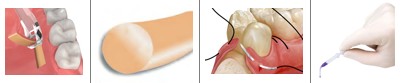
Devices such as the Soft Tissue Harvesting tool by Dental Studio offer the opportunity for a predictable tissue cut.
What about Palatal Graft Fixation?
The use of a monofilament suture with low bacterial resistance offers the best chance of a stable tension. This can be reinforced with the use of a tissue adhesive like High Viscosity Periacryl.
What About the Donor Site?
The palate is a wound that heals from the base up. A deeper harvest makes that wound larger. Leaving at least 2.0 mm of residual tissue on the palate is considered key for secondary-intention healing. Donor site comfort is a key part of the thickness decision, not an afterthought. The use of Periacryl Adhesive or an Oral-Aid self-sealing dressing helps alleviate pain and accelerate healing. The use of a thicker harvest graft can mean:
More discomfort in the first days
Slower closure
A higher risk of bleeding
A longer wait for normal eating
How Do You Measure Thickness?
Clinicians judge depth with a gauge or Perio probe. Some also use a ruler once the graft is out.
What Else Affects the Outcome of soft tissue grafting?
Thickness is one piece of the puzzle. Clinicians planning a free gingival graft should also consider:
Graft handling: keep the tissue moist and handle it gently
Patient habits: smoking and poor oral hygiene slow healing
What Mistakes Should You Avoid?
Rushing the harvest: depth becomes uneven
Using blunt blades: cuts turn rough
Ignoring the donor site: patients struggle at home
Skipping aftercare advice: worry and complaints follow
FAQ: Free Gingival Graft Thickness
Is there one ideal graft thickness?
No. Sources describe 1 to 2 mm, but the best depth depends on the case. Your clinician decides.
Do thicker grafts shrink less?
Not always. Studies disagree. Some link thin grafts to more shrinkage, while others report the opposite.
Does a thicker graft hurt more?
Often, because the palate wound is deeper, creating a need to manage both sites.
Why does a graft need a blood supply?
Living tissue needs nutrients. A graft first feeds from the wound bed. New vessels then grow in.
Conclusion: Choose Depth with Care
Graft depth is a balance. The evidence points to a middle path, but it does not give one fixed number.
Good soft tissue grafting also depends on sharp, reliable and compliant instruments. Those tools help your clinicians stay in control.
Ready to restock? Browse the Regen Store range today, or contact our team for help choosing surgical products for your practice.
Meta title: Soft Tissue Grafting: Free Gingival Graft Thickness. Meta description: Soft tissue grafting depends on free gingival graft thickness. See what the evidence says about healing, shrinkage and donor site comfort. URL slug: soft-tissue-grafting-gingival-graft-thickness.